 Efficient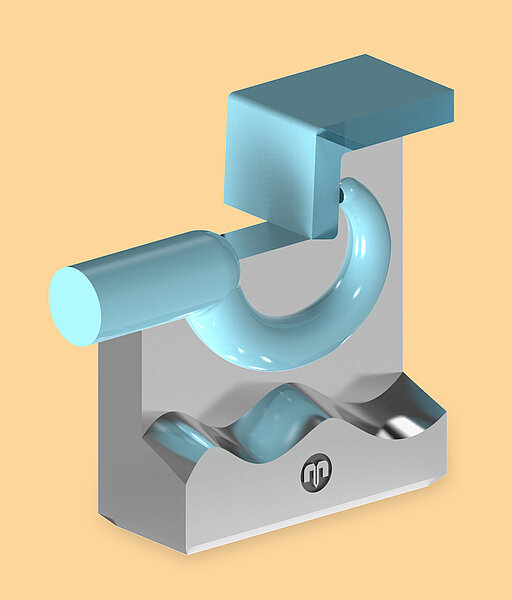
Michelstadt/Germany, July 2026 – At Fakuma 2026, i-mold will be presenting the new TGBL series of its in-house developed tunnel gate inserts, allowing the flow direction of the melt to be redirected by up to 270°. This provides a convenient way of moulding the edges of lids or caps from the inside, thereby avoiding gate marks on their visible side. The new TGBL inserts are suitable for shot weights of 35 g for size 1, 120 g for size 2, and 1000 g for size 3. Thanks to their compact, one-piece design, all three versions require very little installation space in the mould.
The spherical end of the sprue channel in the TGBL inserts provides exceptional flexibility. This ensures that, when contouring to the specific moulded part, the gate is always precisely circular, with its diameter increasing with the depth of material removal, regardless of the angle of the part’s surface.
Due to their large deflection angles and narrow flow channel cross-section, TGBL inserts are ideal for processing thermoplastics with relatively low stiffness, such as polyolefins. The use of fillers and reinforcing materials, including talc or fibres, should be avoided. This prevents the remaining sprue from tearing off in the sharply bent channel after it is first cut off when the mould opens and then pulled out under elastic deformation.
Using highly wear-resistant, standardised and interchangeable tunnel gate inserts significantly reduces the time and effort required for the planning, design, construction and maintenance of injection moulding tools. The metal injection moulding (MIM) manufacturing process ensures high process reliability during production thanks to smooth sprue channel walls and precise gate dimensions. This results in clean injection points with minimal marking on the surface of the moulded part.
Where the high deflection angles achievable with the new TGBL types are not required, the TGLL types allow for gating below the mould parting line on gently sloping surfaces. Furthermore, i-mold’s range of contourable tunnel sprue inserts made from highly wear-resistant hot-work steel also includes the TGML and TGHL types for injection at medium or increased distances above the mould parting line. The range is rounded off by application-specific types from the TGS and TGR series for flat parting lines, the SGC types with a curved runner for gate locations deep inside the part, and the TPS type as a straight standard sub-gate for side-gating.
Andy Walter, managing director of i-mold, comments: “Our newly developed tunnel gate inserts for side gating on the inside of the moulded part perfectly round off our range in this area. This means we can now help injection mould designers in almost every conceivable configuration to position gates where they do not affect the aesthetics of the moulded part. Thanks to our decades of experience, we work closely with the user to accurately identify the best option from the wide range of possibilities available. In addition to the resulting improvement in quality, their use can significantly help to reduce the time to first mould validation.”
About i-mold
For over twenty years, i-mold has been synonymous with a customer-focused approach to producing highly wear-resistant, flow-optimised tunnel gate inserts for injection moulding plastic parts from below or the side without it being visible from the surface. The product range is completed by Heatlock hot runner systems, gate adjusters for shutting off and/or redirecting the melt flow, and the Nanomold mould coating, which protects mould surfaces and prevents sticking and demoulding problems. This range is available to i-mold’s customers either directly or via its global network of distributors.
Further Information:
Andy Walter, i-mold GmbH & Co. KG
Am Kellersgraben 3, D-64720 Michelstadt, Germany
Tel.: +49 6061 97 93 6-10
office@i-mold.com, www.i-mold.de
Editorial Contact and Voucher Copies:
Dr.-Ing. Jörg Wolters, KONSENS Public Relations GmbH & Co. KG
Hans-Böckler-Str. 20, 63811 Stockstadt am Main, Germany
Tel.: +49 6027 99 00 5-13, mail@konsens.de


